

Hiring & Recruiting
AI Interview Fraud in 2026: How Recruiters Can Protect Hiring Integrity
From proxy interviews to undisclosed AI assistance, how hiring teams can verify candidate identity and assess genuine capability without compromising the candidate experience.
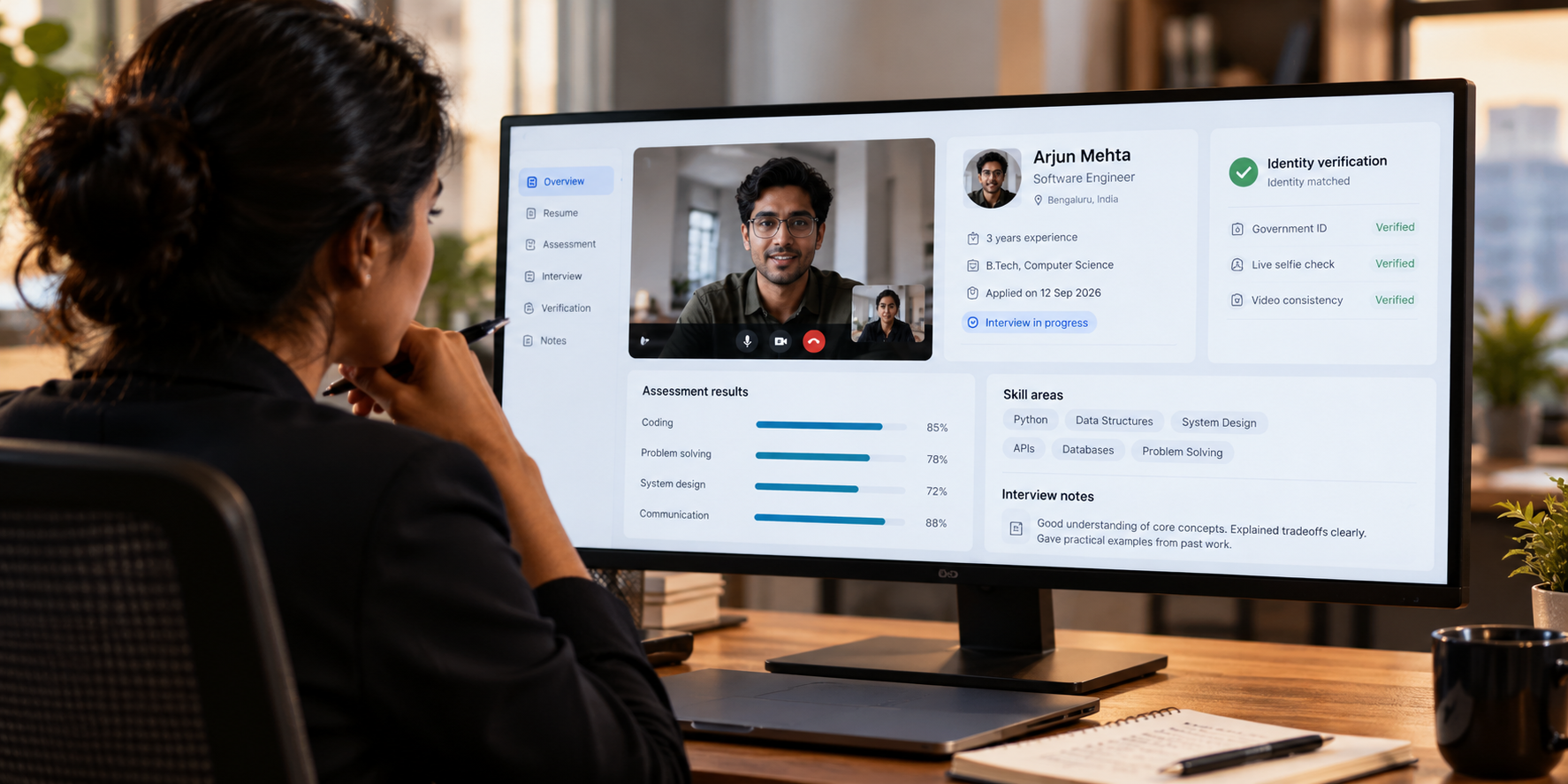
AI Interview Fraud in 2026: How Recruiters Can Protect Hiring Integrity
A candidate clears the resume screening, performs well in the initial assessment and gives convincing answers during the interview. The hiring team makes an offer, only to discover later that the person who completed the evaluation may not be the person who applied.
This is no longer a hypothetical concern for employers hiring remotely.
In July 2026, The Times of India reported that recruiters in India were encountering proxy candidates, hidden AI assistance, remote desktop tools and organised interview-for-hire services. These practices are making it harder to establish whether a candidate has demonstrated their own abilities during recruitment.
For employers, the problem goes beyond cheating in an interview. A hiring decision based on misleading evidence can result in wasted recruitment costs, poor role fit, security concerns and additional work for the team that eventually hires the candidate.
The answer is not to treat every candidate with suspicion. It is to build a hiring process that verifies identity appropriately, tests relevant skills and gives recruiters enough evidence to make informed decisions.
What does AI interview fraud actually look like?
AI interview fraud covers several different practices. Understanding the distinction matters because each requires a different response.
1. Proxy interviews
Another person completes an interview or assessment on behalf of the applicant. The person being evaluated may not possess the skills demonstrated during the session.
2. Undisclosed AI assistance
A candidate uses AI tools to generate answers, solve assessment questions or provide live interview responses in circumstances where that assistance is prohibited.
Using AI is not automatically cheating. Candidates may reasonably use permitted tools during recruitment. The issue is whether the assistance violates the assessment rules or misrepresents the candidate’s own capabilities.
3. Identity impersonation
Someone uses another person’s identity or fabricated identity information to enter the recruitment process.
4. Manipulated video or audio
Synthetic or altered media may be used to misrepresent who is participating in a remote interview.
These risks overlap, but they should not be treated as interchangeable. A candidate using an AI assistant during an assessment presents a different problem from someone impersonating another person.
Why traditional interview processes can miss fraud
Recruitment processes often rely on several assumptions: the person attending the interview is the applicant, the answers reflect their knowledge, and the assessment was completed under the stated conditions.
Remote hiring can make these assumptions harder to verify.
A polished answer does not establish that a candidate has the underlying knowledge. A successful assessment does not, by itself, prove who completed it. A clear video call does not guarantee that the video or audio is genuine.
The National Institute of Standards and Technology (NIST) addresses these challenges in its digital identity guidelines, which discuss identity verification, manipulated media and the limitations of relying on a single verification method.
The practical lesson for recruiters is straightforward: one successful verification step should not be treated as proof that every subsequent stage is trustworthy.
Five ways recruiters can protect hiring integrity
1. Verify identity at the appropriate stages
Identity checks should be proportionate to the role and the risks involved.
For sensitive positions, employers may need stronger identity verification before a consequential assessment or interview. For other roles, a lighter process may be appropriate.
Where verification is required, employers should establish that the person participating matches the identity associated with the application.
A one-time identity check can be useful, but it does not establish that the same person completed every subsequent stage. Employers should determine which additional checks are justified by the role and recruitment process.
2. Test practical skills, not just prepared answers
Candidates can prepare for common interview questions. AI tools can also produce plausible explanations of technical concepts and professional scenarios.
Recruiters should therefore include opportunities for candidates to demonstrate how they approach actual work.
For example, a software engineering candidate might be asked to explain a coding decision, identify a problem in a short piece of code or adapt their solution when a requirement changes.
A data analyst might be asked to explain the assumptions behind an analysis or describe how they would investigate an unexpected result.
These exercises help interviewers explore the reasoning behind an answer rather than judging its presentation alone.
The assessment should remain relevant to the job, and candidates should be told which tools they may use.
3. Connect assessment results with interview performance
An assessment and an interview are more useful when they test related capabilities.
Suppose a candidate performs well in a technical assessment but struggles to explain the approach they supposedly used. That difference may justify a follow-up question or a practical discussion.
It does not automatically prove misconduct.
There may be legitimate explanations, including interview anxiety, unfamiliarity with the format or differences between written and verbal communication.
The appropriate response is to investigate the discrepancy fairly.
Recruiters can ask candidates to walk through their approach, explain a decision or solve a related problem. The aim is to establish capability, not to catch someone out.
4. Establish clear rules for AI use
Employers should not leave candidates guessing about whether AI assistance is permitted.
Before an assessment or interview, communicate:
Whether AI tools are allowed.
Which tools or forms of assistance are prohibited.
Whether the assessment must be completed independently.
How violations will be reviewed.
How candidates can raise concerns about a technical problem or an incorrect flag.
Different roles may require different rules. An AI-enabled role may reasonably include permitted AI use, while a test of unaided programming fundamentals may require a different format.
Clear expectations make enforcement fairer and reduce disputes after an assessment has been completed.
5. Review suspicious activity before making a decision
Automated monitoring can help identify activity that warrants investigation, but a flag is not a verdict.
Unusual response timing, technical interruptions, changes in audio or video quality and inconsistencies in performance can have innocent explanations.
Recruiters should consider the available evidence together, ask follow-up questions where appropriate and allow candidates to explain relevant discrepancies.
Where an automated tool contributes to a hiring decision, employers should understand its limitations and establish a review process for disputed results.
This reduces the risk of rejecting a qualified candidate because of an unreliable signal.
The balance between security and candidate experience
Stronger hiring controls can create their own problems if implemented carelessly.
Excessive monitoring can make candidates uncomfortable, collect unnecessary personal information and introduce barriers for people with disabilities, limited bandwidth or incompatible devices.
Employers should collect only the information needed for a defined purpose, explain relevant checks in advance and provide a reasonable way to resolve verification failures.
A candidate who experiences a legitimate technical issue should not automatically be treated as suspicious.
The objective is to make the process more reliable without turning every interview into an interrogation.
How recruitment technology can help
Managing hiring integrity becomes more difficult when screening, assessments, interviews and candidate records exist in disconnected systems.
A connected recruitment workflow can help employers maintain continuity across these stages.
Depending on the tools and controls available, this may include:
Reviewing candidate information before an assessment.
Applying consistent assessment requirements.
Recording relevant evaluation results.
Comparing assessment performance with interview evidence.
Flagging discrepancies for human review.
Maintaining a clear record of the hiring decision.
VHire brings candidate screening, assessments and interview workflows into a connected recruitment process. This helps hiring teams organise candidate information and evaluate people across multiple stages rather than relying on a single interview or isolated result.
Specific identity verification and fraud-detection capabilities should be assessed against the features available in the relevant VHire configuration. No platform should be assumed to detect every form of impersonation or AI-assisted cheating.
A fairer standard for remote hiring
AI interview fraud is a real concern, but the solution is not to assume that candidates are dishonest or that AI use is inherently improper.
Employers need to distinguish between legitimate preparation, permitted assistance and deliberate misrepresentation.
That requires clear assessment rules, appropriate identity checks, practical evaluation and human review when something does not add up.
The strongest hiring process is not necessarily the one with the most monitoring. It is the one that can establish who was evaluated, what they demonstrated and whether the evidence supports the hiring decision.
Protecting hiring integrity means verifying what matters without losing sight of the person behind the application.
Building a reliable hiring process starts with finding the right opportunities and staying informed about better recruitment practices. Explore the latest job opportunities or visit our blog for practical insights on hiring, candidate evaluation and workforce trends.